
Visionary encounters, supernatural assault and UAP
Re-materializing the contributions of dream science

As I was recently cited in D. W. Pasulka’s book Encounters: Experiences with nonhuman intelligences for my work with sleep paralysis,1 I realize I need to clarify my current position on the overlap between altered states of consciousness and UAP/abduction encounters. Pasulka’s book is brilliant (although best read after her first work on the topic, American Cosmic) and as a religious scholar, Pasulka gives a lot of focus to how sleep paralysis, lucid dreaming and visionary experience necessarily needs to be included in these discussions.
First, a caveat: I am not an expert of UAPs (Unidentified Aerial Phenomena). I don’t know and can’t comment on other aspects of the phenomena in an informed way. Nor can I apply my expertise to the question of legitimacy of non-terrestrial artifacts and biotics as is now being discussed in the halls of US Congress.
However, what I can do is show how my embodied research into sleep paralysis and related visionary experiences can provide some practical tools for those who struggle with these experiences and are scared to go to sleep in case it happens again. In this way, my contribution may viewed as being more relevant to the psychosocial and religious aspects of encounter phenomena.
As such, my contribution is meager but it’s also practical. Bottom line: I have found that folks can protect themselves from victimhood as well as eject from horrifying encounters when their boundaries are being crossed. And what’s more, modern folks can interact in a meaningful way with the hyper-rational and healing sources of information that emanate from these cosmic spaces too, as countless saints, visionaries and mystics have done for eons. Much of those practices are esoteric and unknown, but the phenomena emerges spontaneously from the uninitiated nonetheless. That is the thesis of my little book Sleep paralysis: Hypnagogic visions and visitors of the night, which has been in print now for 14 years, and is now in its 2nd edition.
Many alien abduction accounts have the earmarks of sleep paralysis, with the victims awakening in the bedroom, sensing a presence, noticing they cannot move, and finally, confronting a scary alien being. Sometimes, these accounts go on to describe how the alien takes the victim on a journey to the stars. As UFOlogist Jacques Vallee noted decades ago, the modern abduction narrative has many parallels to historic angel visitations and also of centuries-old fairyland encounters.2 In medical anthropology, this complex of narratives are known as supernatural assault. But far from pleasant, these accounts sometimes end up with the victims being tortured and sexually molested. The abduction account concludes when victims wake up in the bedroom, as if they never had left, but scared out of their wits.
If these victims have never had a lucid dream before or experienced sleep paralysis, they may say, “This was not a dream,” not realizing that hyper-realistic visionary encounters are commonly experienced along the sleep-wake continuum. In the west this includes the modern paradigms of lucid dreaming and reality shifting, but in many indigenous cultures, this way of knowing is much deeper than its signature of “I know I’m dreaming.” Our monophasic culture simply does not value (and sometimes, even acknowledge) the power of altered states of consciousness like lucid dreaming, remote viewing, out of body experineces and other visionary states for gathering valuable information.
Another caveat: I certainly don’t mean to reduce all uncanny phenomena to physical brain states, such as sleep paralysis and hypnagogia. Medical anthropologist David Hufford has been on this beat for decades, carefully recording anomalous experiences from a holistic perspective that neither strictly psychologizes nor materializes the accounts. In my edited two-volume collection Lucid Dreaming: New perspectives on consciousness in sleep (2014), for which Hufford contributed the essay “Lucid dreaming, sleep paralysis and the non-physical,” he writes, “I have been concerned with questioning, evaluating, and eventually challenging those academic ‘traditions of disbelief,’ traditions where ‘dream’ is a convenient means of dismissing extraordinary claims.”3
So we can say this: encounters are not just a dream, ie a fantasy. We have to do some unlearning to respect the power of dreaming, trance and lucidity with and without the bounds of sleep paralysis. To flip this disrespectful assumption, we could say the dreaming is an altered state of consciousness where mystical experiences, encounters with non-human entities, and uncanny information occur. Sleep and its altered states are entryways to multidimensional experience.
And given that Pentagon insiders are reportedly pushing back on disclosure(s) because of the ontological bloodbath that would occur in Evangelical circles, given that encounter is often characterized in government reports as “interdimensional,” and therefore, theological in nature — this seems deeply relevant to my work in dream studies. (Thanks go to transpersonal psychologist Shaye Hudson for the source here.)
I don’t have the time or interest to try to explain anymore to thick boundaried people what it’s like to experience an enchanted weird world. Again, my core motivation is helping folks who do have these experience to learn ways to protect themselves as well as work with the cosmic insights, healing encounters, and ancestral downloads that come from these profound experiences.
And that’s where this substack Archaeology of Consciousness comes in, because materiality is core not only to many encounter-related phenomena but also to the calling of —and protection from— visionary experience.
Enter talisman and amulets. I’m not necessarily saying that these objects are inherently magical. You cannot prove or disprove this line of reasoning in the waking world. Rather, I’m saying that amulets are effective when applied in altered states of consciousness, probably because we are neurologically primed to recognize objects with liminal properties.
As I’ve discussed here on Substack, amulets for protecting against supernatural assault go back for centuries. Just for one example, here’s a 7th century Mesopotamian incantation bowl that features an Aramaic inscription around a Lilith-type entity: perhaps the original sleep paralysis demon.
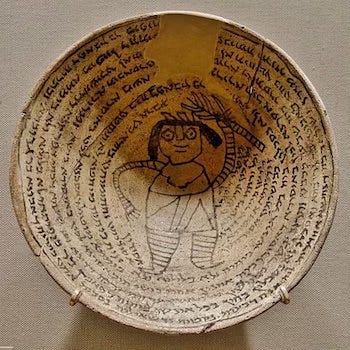
These bowls would be blessed by a Rabbi, and then buried upside down in the house it serves to protect. This text particularly shows that these entities (Lilin) are connected to dreams, as well as afternoon naps. Montgomery (1913) translated the text to read, “Thou, Lilin, male Lili and female Lilith, Hag and Ghoul, be in the ban of [Rabbi] Joshua.. and you should not appear to them [the married couple] either by dream at night or in slumber by day…”
The Lilith traditions are intense, and best documented in relationship to sleep paralysis by medical anthropologist Shelley Adler.
Adler reviews:
One of the most notorious manifestations of the night-mare entity is the female spirit Lilith. The earliest mention of a demonic being that appears to be related to Lilith is found in the Sumerian King list (circa 2400BCE), which states that the water of the great hero Gilgamesh was a Lillu-demon. The Lillu was one of four related evil spirits; the other three were Lilitu, a female demon (probably the prototype for the Hebrew Lilith); Ardat Lili, Lilith’s maidservant, who had sex with men at night and bore demonically hybrid children; and Irdu Lilli, Ardat Lili’s male counterpart who impregnanted women during his nocturnal visits4
Anyways, talisman are effective, and a part of the puzzle.
I’m certainly not alone (that, friends, is an encounter joke) in this notion that the findings of extraordinary experiences have been overlooked in the popular conception of the encounter phenomena — which is probably because these concepts have been used to dismiss the materiality of UAP. David Hufford’s works should be read alongside the work of Jacques Vallée and religion scholars such as D.W. Pasulka.
Rather than dismiss all these accounts as strictly psychological, it is more reasonable to assume that something more than our western atomistic science is at work here. We need more experienced hypnagogic visionaries in the field, dreaming at sacred sites and envisioning at locations where these events are prominent. We need to keep working on how to rematerialize the visionary.
If this interests you, and you are struggling with sleep paralysis and/or working with your own visionary proficiency (or working with clients who are), I’m leading a course starting March 3rd. It’s called Visionary Hypnagogia: sleep paralysis to sacred encounter. It’s hybrid course that bundles recorded lectures on sleep paralysis mastery with new live lectures and discussions on the extraordinary that happens in the imaginal realms of hypnagogia, lucid dreaming and visitations.
You can learn more about the course here.
Pasulka, D.W. (2023). Encounters: Explorations with UFOs, dreams, angels, AI, and other dimensions. St Martins.
Vallee, Jacques (2014). Passport to Magonia: from folklore to flying saucers. Daily Grail Press.
Hufford, David. (2014). Sleep paralysis, lucid dreams and the non-physical, in Hurd and Bulkeley’s (Eds) Lucid dreaming: New perspectives on consciousness in sleep. Santa Barbara: Praeger, p. 255.
Adler (2011). Sleep paralysis: Night-mares, nocebos, and the mind-body connection. Rutgers, pp. 38.
Lucid and helpful. Keep them coming, Ryan.
Excellent post Ryan. Had my own encounters with Lillith, though not all bad I have to say, and over a period of years, some of which unravelled and reravelled a great deal of ancient mythology from both near and afar, and even had relevance for mythic stories still unfolding. It is far too long a tale however. So I often wonder about her demonisation and protection against. Good to be reminded of Hufford's work, which I should revisit. Your course looks great too. Onwards!